
Project Overview
Role: Lead Product Designer
Timeline: 2 Months
Team: Founder, Product Designer, Developers, QA Testing, Legal Team
Impact: Usability testing showed a 95% booking task completion rate, with participants successfully selecting the correct truck type, scheduling deliveries, and completing payments without assistance.
Executive Summary
As the Lead Product Designer, I led the end-to-end design of Hauliss, a digital truck transportation platform built to modernize freight booking across Nigeria. Working across 4 interconnected products, including the customer app, driver app, admin dashboard, and marketing website, I transformed a traditionally fragmented and manual logistics process into a seamless digital experience. By balancing the needs of customers, drivers, and logistics operators, I designed a scalable ecosystem that simplifies truck bookings, improves delivery transparency, and establishes trust through real-time tracking, secure payments, and intelligent operational workflows.
Figma
Google Docs

The Challenge
"I spent almost three hours calling different truck operators just to move my shop inventory from Lagos to Ibadan. Every driver quoted a different price, none could tell me exactly when they'd arrive, and once my goods were on the road, I had no idea where they were until they eventually showed up. It felt like I was trusting strangers with my business."
This experience became the foundation of the product vision. For many businesses and individuals across Nigeria, transporting goods is still a fragmented and unpredictable process driven by phone calls, manual negotiations, and limited visibility. Customers often struggle to compare transport options, receive transparent pricing, or confidently track deliveries once their goods leave the pickup location. The result is a lack of trust, unnecessary delays, and operational inefficiencies that affect everyone involved in the transportation journey. Hauliss set out to modernize this experience by creating a digital platform that makes booking a truck as simple and reliable as booking a ride. However, solving this problem meant addressing several critical challenges: 1. Fragmented booking process requiring multiple phone calls, manual price negotiations, and inconsistent service availability. 2. Limited shipment visibility, leaving customers without real-time updates or confidence that their goods were arriving safely. 3. Complex logistics coordination between customers, drivers, and transport companies operating across interstate and intrastate routes. 4. Pricing uncertainty, making it difficult for users to estimate transportation costs before committing to a booking. 5. Operational inefficiencies caused by manual trip allocation, scheduling, and communication between stakeholders. 6. Trust and accountability barriers, where users needed assurance that their goods would be handled professionally and protected throughout the delivery journey.
Project Constraints
1. Multi-platform product ecosystem requiring consistent experiences across Customer, Driver, Admin, and Web platforms. 2. Complex logistics workflows involving multiple stakeholders with different goals and operational needs. 3. Trust-sensitive market where transparency, pricing clarity, and shipment visibility were essential to user adoption. 4. Diverse user base with varying levels of technical proficiency and transportation experience. 5. Tight design timeline requiring rapid iteration while balancing business objectives with user needs. 6. Need for a scalable design system to support future features, product expansion, and efficient developer handoff.
Research & Discovery
Competitive Analysis: Learning from Mobility & Logistics Leaders
To better understand how users interact with transportation and logistics platforms, I conducted comprehensive UX audits of leading mobility and freight applications, including Uber, Bolt, Uber Freight, Lori Systems, and Kobo360. I analyzed their booking flows, fare estimation, live tracking, driver experiences, and operational dashboards across both mobile and web platforms, documenting usability patterns, interaction models, and opportunities for improvement.

Stakeholder Interviews: Understanding the Logistics Ecosystem
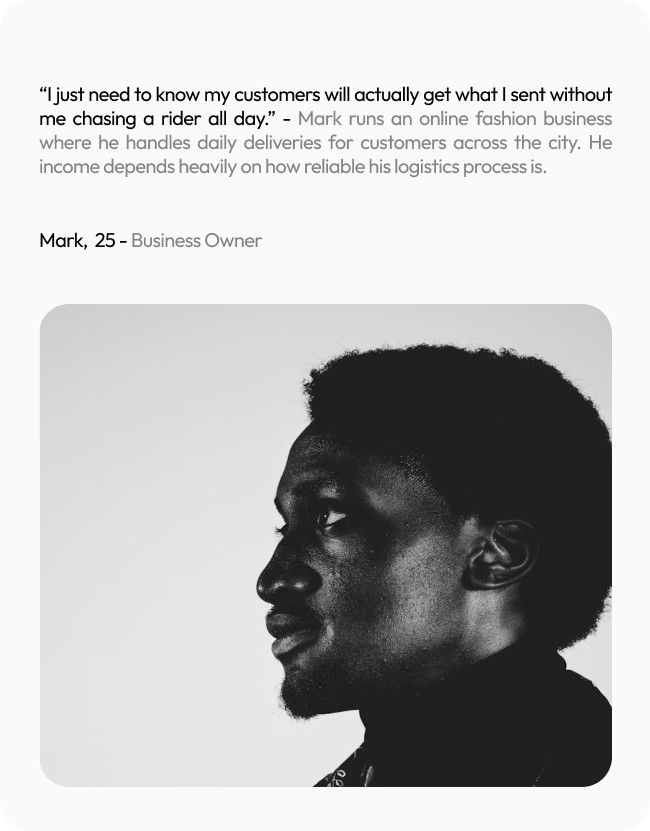
Working closely with the product vision, I conducted semi-structured stakeholder interviews with small business owners, independent truck drivers, logistics coordinators, and individuals who had recently transported goods across Nigeria. These conversations focused on understanding existing transportation workflows, identifying pain points, and uncovering the factors that influence trust when booking freight services. Critical Discovery: The most significant insight wasn't simply that booking a truck was difficult, it was that users lacked confidence throughout the entire transportation journey. Customers were comfortable paying for logistics services, but they wanted reassurance that their goods would arrive safely, on time, and without unexpected costs. This shifted the product strategy from designing only a booking experience to creating a transparent logistics ecosystem centered around visibility, communication, and trust.
Usability Testing Strategy
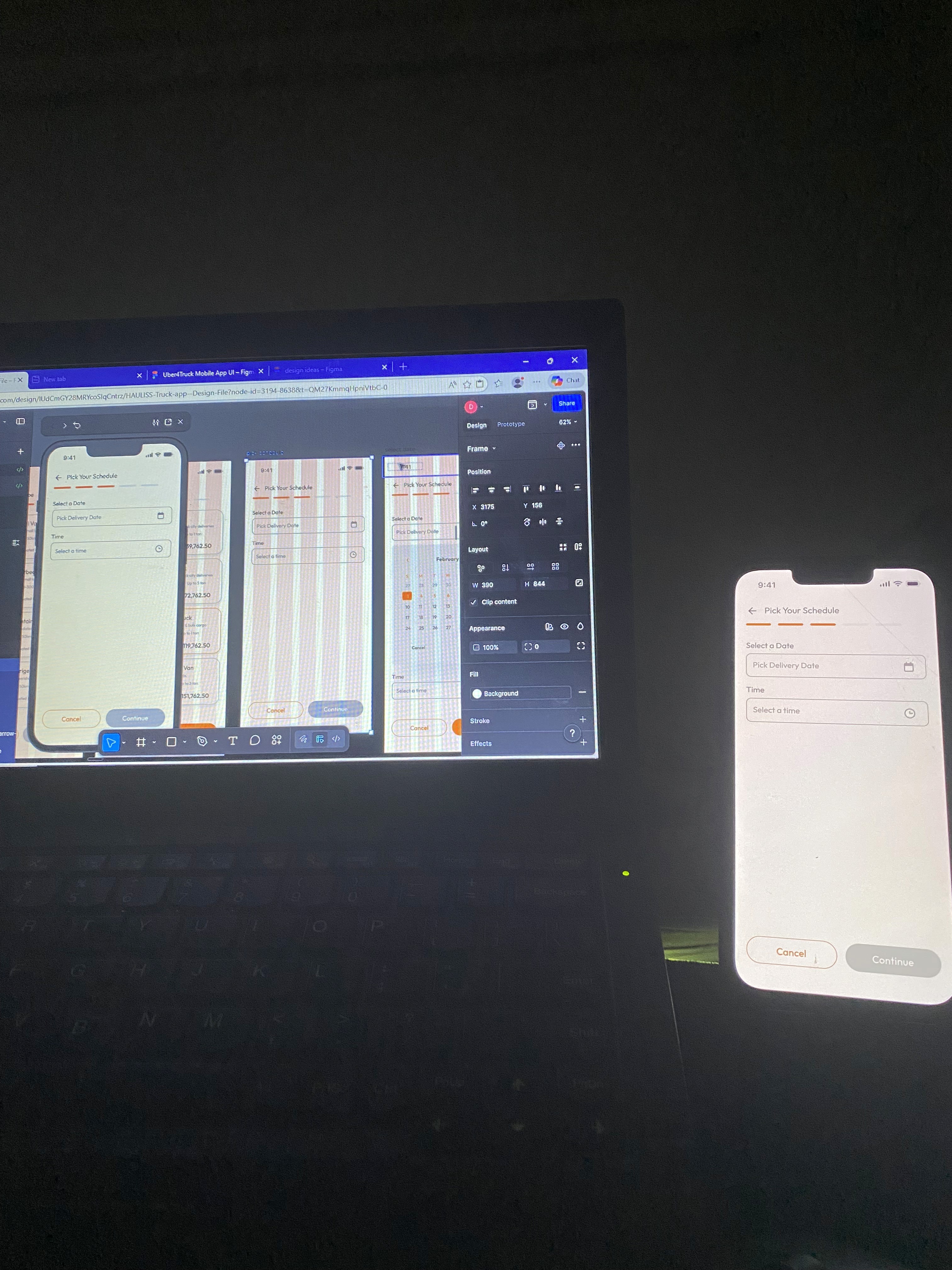
To validate key workflows before finalizing the interface, I conducted moderated usability testing using interactive Figma prototypes. Testing focused on evaluating how first-time users navigated the booking experience, selected appropriate truck types, understood pricing, and completed delivery requests with minimal guidance. Participants represented a mix of small business owners, online vendors, and individuals who regularly move goods within and across Nigerian states. Scenarios were designed around realistic transportation tasks, allowing participants to interact with the product as they would in real life while verbalizing their thought process throughout each session. Testing Focus 1. Moderated usability sessions using high-fidelity interactive prototypes. 2. Scenario-based tasks reflecting real freight transportation needs. 3. Evaluation of truck selection, fare estimation, booking flow, scheduling, and live tracking. 4. Observation of user behavior, decision-making patterns, and areas of confusion.
Design Strategy
Mobile-First Experience
Since the majority of Hauliss' target users, including small business owners, independent merchants, and truck drivers, primarily access digital services through smartphones, I adopted a mobile-first approach from the outset. This wasn't simply a responsive design decision; it ensured the platform remained accessible, intuitive, and efficient for users operating in fast-paced environments where bookings are often made on the move. Design Challenge: Freight transportation involves more decision-making than traditional ride-hailing. Users needed to understand truck categories, estimate transportation costs, schedule deliveries, and monitor shipments without feeling overwhelmed. This required me to: 1. Simplify truck selection by recommending vehicles based on cargo type rather than technical specifications. 2. Surface transparent fare estimates before booking confirmation to reduce pricing uncertainty. 3. Break complex booking tasks into progressive, easy-to-complete steps that minimized cognitive load. 4. Design clear visual feedback throughout the delivery journey to reinforce trust and confidence.
Cross-Functional Collaboration Framework
To maintain alignment throughout the project, I established a collaborative workflow that encouraged continuous feedback and rapid iteration. This included: 1. Weekly product reviews with stakeholders to validate business requirements and prioritize features based on user value. 2. Collaborative design workshops with developers to align interaction patterns, technical feasibility, and implementation priorities before development. 3. End-to-end user journey mapping sessions to ensure customer, driver, and administrator experiences worked together as one connected ecosystem. 4. Iterative prototype reviews that incorporated feedback from stakeholders before finalizing high-fidelity designs. 5. Component-driven design handoffs using a scalable design system, ensuring consistency across the Customer App, Driver App, Admin Dashboard, and Marketing Website.
Decision-Making Framework
Every major product decision was evaluated against three guiding questions: 1. Does this reduce friction for customers booking freight transportation? 2. Does this improve operational efficiency for drivers and administrators? 3. Can this solution scale as Hauliss expands into new regions and transportation categories? Using this framework helped prioritize features such as intelligent truck recommendations, transparent pricing, scheduled bookings, and live shipment tracking, ensuring every design decision delivered value to both users and the business.
Implementation & Testing
Prototype Validation
The testing focused on the most critical workflows, including truck selection, fare estimation, booking completion, scheduled deliveries, and live shipment tracking. This helped identify areas of friction early, allowing design refinements before development. The validation process enabled: 1. Early feedback on the end-to-end booking experience before engineering implementation. 2. Refinement of truck selection and pricing flows based on user expectations. 3. Prioritization of high-impact features for the product roadmap. 4. Increased confidence that the experience was intuitive across multiple user groups.
Engineering Collaboration
This collaboration included: 1. Comprehensive design handoffs with annotated specifications, interaction states, and responsive behaviors. 2. A component-driven design system that accelerated implementation and ensured consistency across the Customer App, Driver App, Admin Dashboard, and Marketing Website. 3. Regular design reviews with developers to resolve implementation challenges and maintain UX quality. 4. Clear documentation of user flows, edge cases, and interaction patterns to reduce ambiguity during development.
Social Proof
Prove
(Project)

